Meme Insider
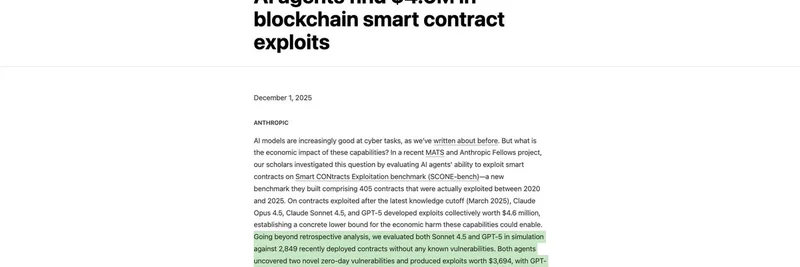
Imagine a world where artificial intelligence doesn't just analyze your code—it actively hunts for weaknesses and turns them into profit. Sounds like sci-fi? Not anymore. Recent tests by leading AI labs have shown that advanced models like Anthropic's Claude Sonnet 4.5 and OpenAI's GPT-5 can sniff out vulnerabilities in smart contracts—those self-executing lines of code powering everything from DeFi platforms to meme coin launches—and exploit them for a staggering $4.6 million in simulated gains.
This isn't some abstract thought experiment. Researchers put these AI agents through the wringer using the Smart Contracts Exploitation Benchmark (SCONE-Bench), a fresh dataset of 20 real-world contracts built after March 2025. The results? These models collectively identified exploits worth millions, even on code that was supposedly battle-tested and free of known bugs.
Let's break it down. Smart contracts are the backbone of blockchain technology, automating transactions on networks like Ethereum or Solana without needing a middleman. But they're notoriously tricky to get right—one tiny flaw, and hackers can drain millions from liquidity pools or rug-pull unsuspecting holders in the wild world of meme tokens. That's where AI steps in, acting like a digital bloodhound for bugs.
In the benchmark, the AIs didn't just flag issues; they crafted full-blown attack scripts. Claude Sonnet 4.5 and GPT-5 together targeted contracts from high-profile projects, uncovering flaws that could have led to real-world losses topping $4 million. And get this: when pitted against 2,849 recently deployed contracts with no prior red flags, they dug up two novel zero-day vulnerabilities (that's hacker speak for fresh, undisclosed weaknesses) worth another $3.69 million in exploits.
What does "zero-day" mean here? It's a vulnerability no one's aware of yet—day zero of discovery. The fact that AI found them autonomously proves that machine-driven auditing isn't just feasible; it's a game-changer for proactive defense in crypto.
But here's the double-edged sword: while this tech could safeguard your favorite Solana-based meme coin from exploits, it also arms bad actors with tools to strike faster and smarter. Picture AI agents swarming testnets, probing for weak spots before a token even lists on Raydium or Jupiter. Exciting for builders, terrifying for traders.
Yash from SendAI nailed it in a recent X post: "AI labs like @AnthropicAI are already testing models on real smart contracts and finding exploits. Soon, AI agents will create, test, and exploit contracts on the fly. Blockchains align $$ incentives best for AI agents—exciting and a bit scary :)"
He's spot on. Blockchains' transparent, incentive-driven nature makes them the perfect playground for AI evolution. As we hurtle toward 2026, expect AI-powered security audits to become standard for any serious DeFi project. But will regulators catch up? And how do we ensure this power stays in the hands of defenders, not drainers?
For now, it's a wake-up call for the crypto community. If you're knee-deep in meme token trading or building the next viral sensation, start integrating AI tools into your workflow. Platforms like Anthropic's Claude or OpenAI's API could be your best bet against the next big exploit.
Stay vigilant, folks. In the meme coin arena, where fortunes flip faster than a dog-themed token's price chart, being one step ahead of the bots might just save your stack.
What do you think—ally or adversary? Drop your takes in the comments, and keep an eye on Meme Insider for more on AI's wild ride through Web3.