 Meme Insider
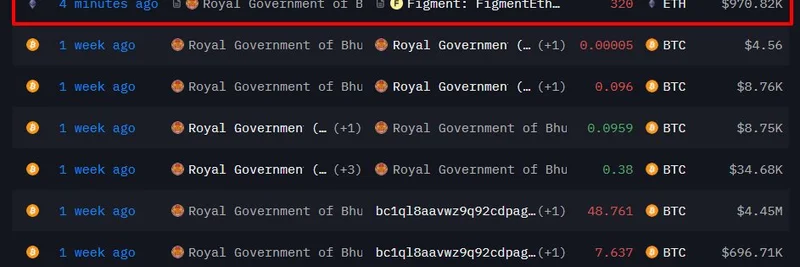
Hey crypto enthusiasts, have you heard about the Himalayan kingdom making waves in the blockchain space? The Royal Government of Bhutan just made a notable transaction, sending 320 ETH—that's Ethereum's native cryptocurrency, worth around $920,800 at the time—to Figment for staking in ETH 2.0. This move was spotted by on-chain analytics tool Onchain Lens, highlighting how even sovereign entities are getting deeper into decentralized finance.
For those new to the term, staking involves locking up cryptocurrency to support a blockchain network's operations, like validating transactions, in exchange for rewards. ETH 2.0 refers to Ethereum's upgrade to a proof-of-stake consensus mechanism, which is more energy-efficient than the old proof-of-work system used by Bitcoin. Figment, a leading staking provider, helps institutions like this securely participate in such networks.
This isn't Bhutan's first rodeo in crypto. Through its sovereign investment arm, Druk Holding and Investments (DHI), the country has been quietly mining Bitcoin since 2019, leveraging its abundant hydropower for eco-friendly operations. According to data from Arkham Intelligence, Bhutan holds around 12,000 BTC, making it one of the few governments publicly involved in cryptocurrency holdings. They've even sold portions of their Bitcoin stash recently, moving over $62 million worth to exchanges like Binance in the past few months, as reported in various crypto news outlets.
What's interesting here is Bhutan's diversification into Ethereum. Beyond mining BTC, the kingdom is now anchoring its National Digital Identity (NDI) platform on the Ethereum blockchain, with a full migration expected by early 2026. This shift from Polygon to Ethereum aims to enhance security and give citizens self-sovereign control over their identities. It's a bold step that could inspire other nations to explore blockchain for public services.
Why does this matter for the broader crypto ecosystem? Sovereign involvement like Bhutan's adds legitimacy and stability to the market. As more governments dip their toes—or in this case, stake their ETH—it could drive adoption, potentially influencing meme tokens and other volatile assets by boosting overall confidence. Plus, with Bhutan's focus on 'green' crypto using renewable energy, it sets a positive example amid growing environmental concerns in the industry.
If you're tracking on-chain activities, check out the entity's explorer page on Arkham for more details on DHI's transactions. Moves like this remind us that crypto isn't just for retail traders; it's going institutional, and even royal.
Stay tuned for more updates on how nations are embracing blockchain—it's shaping up to be a game-changer.