 Meme Insider
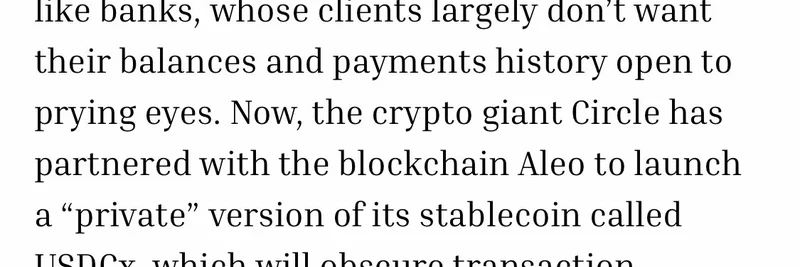
Ever feel like blockchain's biggest strength—its total transparency—is also its Achilles' heel? Every transaction is out there for the world to see, like a financial diary left wide open on the kitchen table. For everyday crypto users, that's often a feature, not a bug. But for big banks and institutions? It's a nightmare. Their clients—think high-net-worth folks and corporations—don't want their balance sheets or payment histories splashed across a public ledger for competitors or regulators to dissect.
That's where Circle, the powerhouse behind the ubiquitous USDC stablecoin, is shaking things up. Teaming up with the privacy-focused Aleo blockchain, they're rolling out USDCX: a "private" version of USDC designed to cloak transaction details while keeping the dollar peg intact. According to a fresh Fortune report, this isn't just another stablecoin tweak—it's a direct response to the privacy roadblock that's kept traditional finance at arm's length from crypto.
Why Privacy Matters in Stablecoins
Let's break it down simply. Stablecoins like USDC are blockchain's killer app for payments and trading: fast, cheap, and always worth a buck. But because blockchains are public databases, anyone can trace flows. Want to send $1 million to a supplier? Congrats—your entire network now knows about it.
Enter zero-knowledge proofs (ZKPs), the cryptographic wizardry that Aleo specializes in. ZKPs let you prove something is true (like "I have enough funds") without revealing the details (like exactly how much or to whom). Howard Wu, Aleo's co-founder, told Fortune this setup delivers "banking-level privacy" on-chain. No more prying eyes—just verifiable, shielded transactions.
For institutions, this is huge. Imagine settling cross-border payments or managing treasury reserves without exposing strategies. It's like Venmo for whales, but with crypto's speed and global reach.
The Circle-Aleo Power Play
Circle isn't new to stablecoins—they've minted billions in USDC since 2018. But as regulatory scrutiny ramps up (hello, MiCA in Europe and clearer U.S. guidelines), privacy has become table stakes. Aleo, built from the ground up for ZK apps, was the natural fit. Their platform uses "zkSNARKs" (a type of ZKP) to obscure data while ensuring everything adds up.
The launch of USDCX means:
- Shielded Transfers: Send USDCX without broadcasting amounts or addresses.
- Compliance Built-In: Regulators can audit proofs without seeing sensitive info.
- Seamless Integration: Works like regular USDC but with an opt-in privacy layer.
Wu emphasized that this isn't about going fully anonymous—it's targeted privacy for those who need it, aligning with real-world finance needs.
Broader Implications for Crypto and Memes?
The X (formerly Twitter) buzz around Degenerate News's post is electric, with replies hailing it as "ZK season" finally arriving. One user quipped, "Aleo getting this deal shows zero-knowledge season is finally real." Another pondered why not Zama's tech instead—classic crypto tribalism.
But let's zoom out to meme tokens, our bread and butter at Meme Insider. Privacy tech like this could supercharge meme ecosystems. Think: anonymous airdrops, shielded whale dumps (or pumps), and meme DAOs handling funds without doxxing members. Dogecoin or PEPE on a private layer? It'd make rug pulls harder to spot but also empower genuine community plays. As stablecoins like USDCX bridge TradFi and DeFi, expect more memes to layer on privacy for that elusive "institutional grade" vibe.
What's Next for USDCX and Aleo?
Circle hasn't dropped a full launch date yet, but whispers point to early 2026 pilots with select partners. Aleo's mainnet is already live, so integration should be swift. Keep an eye on $ALEO token—partnerships like this often spark rallies.
In a world where data is the new oil, USDCX is Circle's bet on privacy as the new lubricant for adoption. Whether you're a degen chasing memes or a suit eyeing on-chain yields, this feels like the unlock we've been waiting for. What do you think—game-changer or just hype? Drop your takes below.
Stay tuned to Meme Insider for the latest on how privacy waves are crashing into meme token seas. We've got your back on all things blockchain and beyond.