 Meme Insider
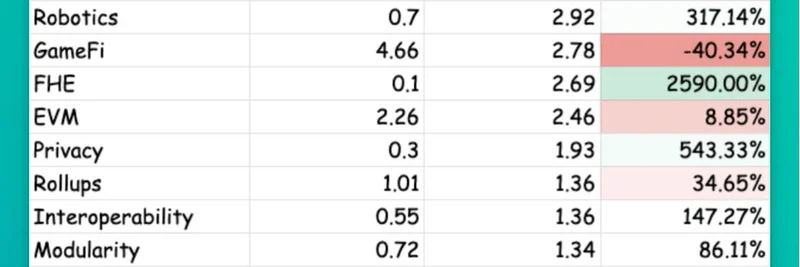
Have you ever wondered what crypto folks are buzzing about today versus last year? It's not just about prices ticking up or down—it's the stories, the hype, the narratives that drive the market. A fresh chart from Kaito AI, shared by crypto analyst Sandra Leow, breaks down "narrative mindshare" in the blockchain world. Think of mindshare as the slice of conversation pie each topic gets on social media and forums. It's a pulse check on what's hot and what's not.
This data compares December 2024 to December 2025, showing how investor chatter has evolved over the year. Spoiler: Some sectors are sprinting ahead, while others are catching their breath. Let's dive into the standout shifts, especially since we're knee-deep in meme coin mania at Meme Insider. We'll keep it straightforward—no PhD in blockchain required.
DeFi's Big Comeback: From Niche to Must-Watch
Decentralized Finance (DeFi) is the OG of crypto innovation—lending, borrowing, and trading without banks. In Dec 2024, it grabbed just 9.3% of the mindshare pie. Fast-forward to Dec 2025, and it's doubled to 19.06%. That's a whopping +104.95% jump!
Why the surge? Simple: Real-world adoption. With regulatory clarity on the horizon (hello, potential U.S. stablecoin laws), more everyday users are dipping toes into DeFi pools. If you're a meme token hunter, this means hybrid projects blending fun with yields could be the next wave. Pro tip: Watch for DeFi-meme crossovers—they're stealthily building utility under the viral hood.
Meme Coins: The Hype Cycle Hits a Wall
Ah, memes—the heart and soul of our site. Dog-themed tokens and frog armies ruled 2024 with 9.7% mindshare. But by Dec 2025? Down to 3.33%, a -65.67% nosedive. Ouch.
Don't panic-sell your PEPE bags just yet. This dip screams "maturation." Early 2024 was peak degeneracy; now, investors want memes with meat on their bones—like community governance or NFT integrations. At Meme Insider, we're seeing resilient underdogs rise: Tokens with strong holder loyalty and real dev teams. The lesson? Memes aren't dying; they're evolving. Look for those with DeFi ties to rebound hard.
Prediction Markets: The Sleeper Hit Exploding 1960%
Hold onto your hats—this one's wild. Prediction markets (betting on real events via blockchain, like election outcomes) went from a measly 0.2% in Dec 2024 to 4.12% in 2025. That's a mind-blowing +1960%!
Powered by platforms like Polymarket, these tools turned crypto into a crystal ball during the 2024 elections. Now, with global events ramping up, they're the go-to for hedging bets on everything from sports to stock moves. For meme enthusiasts: Imagine prediction markets for viral token pumps. Game-changer? Absolutely.
Other Big Movers Worth Your Radar
- ZK Tech (Zero-Knowledge Proofs): Privacy's best friend, but mindshare halved from 14.9% to 5.18% (-247.65%? Wait, that's relative math—still key for scaling Ethereum).
- Stablecoins & RWA (Real-World Assets): Steady climbers at +51.10% and +215.56%. Tokenizing real estate or bonds? That's bridging TradFi and crypto.
- Robotics & FHE (Fully Homomorphic Encryption): Niche but nuts—+317.14% and +2590%! AI-blockchain mashups are cooking.
- x402 (Whatever That Is): Peaked at 3.40% mid-year, now cooling at 0.82% (+810% overall). Noisy hype, classic crypto.
- DePIN (Decentralized Physical Infrastructure): Rough ride, down 65.47%. Hardware networks like Helium are consolidating.
The "Others" bucket shrank 40.85%, meaning narratives are consolidating around winners.
What Does This Mean for Meme Token Traders?
At Meme Insider, we live for the chaos, but data like this is gold. The meme fade? It's a buy-the-dip signal for quality plays. Pair it with rising DeFi or prediction market vibes, and you've got alpha. Crypto's not random—narratives shift like seasons. Right now, utility is king.
Curious about specific meme projects riding these waves? Drop a comment or hit our knowledge base for deep dives. What's your take on the meme slump—temporary or toast? Let's chat.
(Data sourced from Kaito AI via Sandra Leow's X post. Mindshare % reflects conversational dominance, not market cap.)