Meme Insider
Hey crypto enthusiasts, if you've been keeping an eye on the evolving landscape of blockchain tech, you've likely come across DePIN—or Decentralized Physical Infrastructure Networks. These are essentially crowdsourced networks where everyday people contribute hardware like wireless hotspots or sensors to build out real-world infrastructure, getting rewarded with tokens in the process. It's a game-changer, shifting power from big corporations to users.
Recently, a tweet from @0xSammy (original tweet here) caught our attention at Meme Insider, shedding light on this trend. Sammy points to a fresh report from venture capital giant A16z, emphasizing how DePIN is exploding and setting the stage for the massive robotics industry.
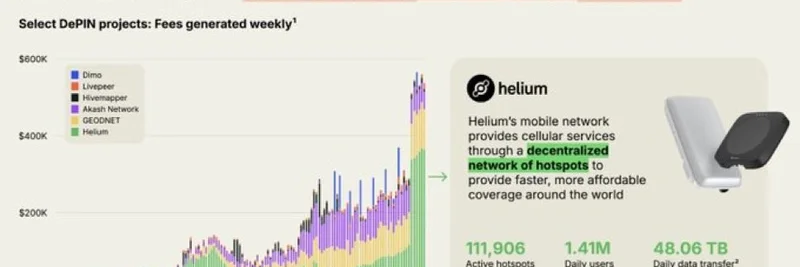
Take a look at this chart shared in the tweet—it's eye-opening. It tracks weekly fees generated by top DePIN projects like Helium, GEODNET, Akash Network, Hivemapper, Livepeer, and Dimo. Starting from humble beginnings in 2023, the fees have skyrocketed, especially in 2025, with Helium leading the pack. Helium's mobile network alone boasts over 111,000 hotspots, serving 1.4 million daily users and transferring 48.06 TB of data daily. That's not just numbers; it's real utility driving revenue.
Sammy argues that while stablecoins are stealing the spotlight for their efficiency (think insane revenue per employee), DePIN and its AI cousin DePAI (Decentralized Physical AI) are on the cusp of a breakthrough. Once physical AI—like robots—taps into these networks, we're talking about a multi-trillion-dollar shift. He even mentions snagging a GEODNET station for a review, highlighting its geospatial data prowess and consistent growth.
This aligns perfectly with A16z's State of Crypto Report 2025, which positions DePIN as the next big frontier after DeFi revolutionized finance. The report cites the World Economic Forum's projection: DePIN could balloon to $3.5 trillion by 2028. Helium is flagged as the poster child, but the potential spans telecom, energy grids, and transportation.
Now, you might be wondering—how does this tie into meme tokens? At Meme Insider, we see DePIN as the utility backbone that could supercharge the next wave of meme hype. These projects often start with token incentives that attract speculative buzz, much like memes, but they deliver tangible value. Think about it: as regulations like the Clarity ACT progress, aligning fees with token holders, we could see meme-like pumps backed by real earnings. It's the evolution from pure fun to functional fun in crypto.
Sammy also nods to the "hockey stick moment"—that exponential growth phase fueled by network effects from millions of user-run nodes. With crypto's market cap over $4 trillion and stablecoins eyeing $3 trillion by 2030, DePIN's role in mainstream adoption is undeniable.
If you're dipping into blockchain, keep tabs on DePIN. Projects like these aren't just trends; they're building the infrastructure for tomorrow's tech. Got thoughts on DePIN's meme potential? Drop them in the comments below. For more insights, check out our knowledge base on emerging crypto narratives.