Meme Insider
If you've been scrolling through crypto Twitter lately, you've probably stumbled upon the buzz around the "Great L1 Debate." It pitted Haseeb Qureshi, the sharp-minded managing partner at Dragonfly Capital, against Santiago Roel in a deep dive on the future of Layer 1 blockchains. The debate didn't just spark clips and hot takes—it ignited real conversations about where Ethereum and the broader blockchain ecosystem are headed. And Trent Van Epps, a key figure in Ethereum's protocol coordination at the Ethereum Foundation, just dropped a gem of a summary that's got everyone rethinking the big picture.
The Debate at a Glance
Haseeb and Santiago went head-to-head on the trade-offs of L1 scaling. For the uninitiated, Layer 1 (L1) refers to the base blockchain networks like Ethereum—the foundational infrastructure where everything else builds on top. The core tension? Should we double down on optimizing what's right in front of us, or swing for the fences with bolder, paradigm-shifting bets?
Santiago, grounded in practical realities, argued for focusing on the "ground in front of him"—tackling immediate challenges like transaction throughput, fees, and developer experience. It's a pragmatic approach: make the current system work better before chasing moonshots.
Haseeb, ever the visionary, flipped the script. He bet on "escaping the local Pareto gravity well." Let's break that down without the jargon overload. The Pareto frontier is a concept from economics and optimization—think of it as the edge where you're getting the most bang for your buck, but it's "local" if you're stuck in a suboptimal spot. The "gravity well" is that sticky pull keeping you there. Haseeb's thesis: Crypto isn't just about tweaking knobs; it's about breaking free to build entirely new worlds, like network-native economies where value flows seamlessly across borders without middlemen.
And here's where it gets wild—Trent's summary amps it up: "even as compelling as network-native economies are, imagine them with network-native minds." We're talking AI agents, not just smart contracts. Picture autonomous digital entities that think, trade, and evolve on-chain, turning blockchains into living, breathing ecosystems.
Trent's Visual Take: Why Betting Big Pays Off
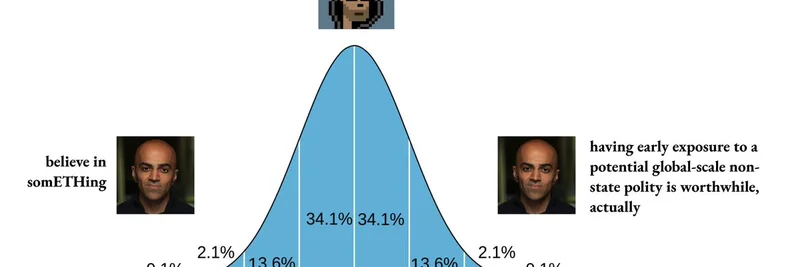
Trent didn't stop at words. He paired his summary with a striking graphic—a stylized normal distribution curve overlaid with his pixelated avatar and photos of himself. The x-axis runs from 55 to 145 (likely a nod to IQ or capability scales, but in this context, it's about potential outcomes). The curve peaks at 100, representing the "local" baseline, but the real story is in the labels:
- 68% (mean ±1σ): The safe, predictable zone where most efforts land.
- 95% (±2σ): The outliers that deliver real wins.
- Tails at 0.1% and 2.1%: The rare, explosive upsides—like early exposure to a "potential global-scale non-state polity."
Trent's caption? "i'm (just) a business, man" alongside "believe in som[E]TH[ing]" and the kicker: "having early exposure to a potential global-scale non-state polity is worthwhile, actually."
It's a meme-worthy reminder in a sea of spreadsheets: In crypto, the fat tails rule. Sure, 99% of projects flop, but that 1%? It could redefine governance, finance, and society. Non-state polities—think decentralized autonomous organizations (DAOs) on steroids—aren't just hype; they're the next evolution of Web3.
Why This Matters for Meme Token Hunters and Builders
At Meme Insider, we live at the intersection of viral culture and blockchain innovation. This debate isn't abstract—it's a blueprint for spotting the next big meme token or protocol. If Haseeb's right, we're on the cusp of L1s that host not just tokens, but intelligent economies. Imagine meme coins backed by AI-driven DAOs, where community governance feels alive, not scripted.
Trent's point hits home for anyone grinding in this space: Early bets on Ethereum's wild potential have minted fortunes and shaped history. From Uniswap to Aave, the winners escaped the gravity well.
What's Next in the L1 Wars?
The debate's just the start. With Ethereum's Dencun upgrade behind us and Prague on the horizon, expect more fireworks. Will we grind local optima, or launch into the stars? Follow the thread on X and weigh in—who won?
If you're building or investing in meme tokens with real utility, this is your signal. Escape the well, believe in something bigger, and let's build the future—one block at a time. What's your take? Drop it in the comments.
For more on Ethereum's edge in the meme economy, check our knowledge base.