Meme Insider
In the ever-evolving world of blockchain, few moments feel as satisfying as watching a major upgrade roll out without a single stutter. That's exactly what happened with Ethereum's Fusaka upgrade on December 3, 2025—a seamless shift that had Layer 2 (L2) networks firing on all cylinders, posting data blobs like clockwork. If you're knee-deep in meme tokens or just dipping your toes into Ethereum's tech waters, this is the kind of news that signals smoother sailing ahead for everyone.
Terence Kwok, a sharp voice in the Ethereum community, captured the vibe perfectly in his recent X post: "Fusaka went well, and L2s posting blobs without missing a beat. Credit to all the teams. L1 and L2s running as one well-oiled machine that moves forward together." It's a nod to the collaborative grind behind the scenes, where developers from the Ethereum Foundation and L2 builders like Optimism and Arbitrum synced up to make this happen. No drama, just progress.
For the uninitiated, blobs are Ethereum's clever way of handling large chunks of data more efficiently—think of them as lightweight packages for off-chain info that L2s use to keep transactions cheap and fast. Post-Dencun (Ethereum's last big data tweak earlier this year), blobs have been a game-changer for scaling, slashing fees and boosting throughput. Fusaka? It's the next evolution, fine-tuning those mechanics to handle even more load without breaking a sweat.
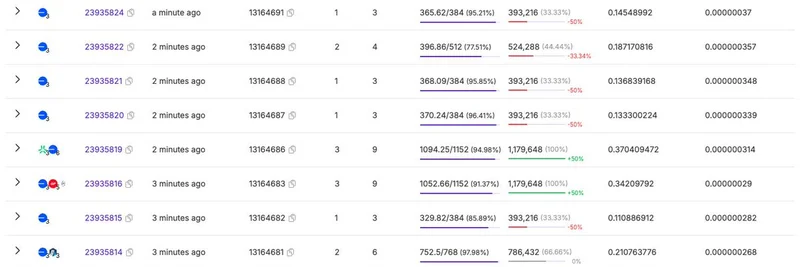
What really caught my eye in Terence's thread was the attached data snapshot—a real-time peek into recent Ethereum blocks. It's like a dashboard for the network's heartbeat, showing how blobs are performing right after the upgrade. Let's break it down in simple terms:
This table tracks the last 15 or so blocks, highlighting metrics like block number, age, transactions (Txs), blob count, usage in KB, gas consumption in Gwei, base fees, and blob prices. Here's the gist:
- Blob Activity Surge: Most blocks are packing 3 to 9 blobs, with usage spiking to full capacity (like 1,176 KB at 100% in several slots). That's L2s taking full advantage—no hesitation post-upgrade.
- Gas Efficiency Wins: Gas usage hovers between 262K to 1,150K Gwei per block, but the real story is the low blob base fees (often under 0.000001 Gwei). Compare that to pre-upgrade peaks, and it's clear Fusaka is keeping costs in check.
- Network Rhythm: Ages range from seconds to minutes, with slots filling steadily. No massive backlogs—Ethereum's processing like a pro.
Diving deeper, you'll spot patterns: Blocks with higher blob counts (e.g., 9 blobs) correlate with near-100% usage, pushing gas up slightly but still staying affordable. Fees are microscopic, which is music to the ears of meme token traders who hate getting rekt by gas wars during pumps.
Why does this matter for meme insiders like us? Meme tokens thrive on virality—quick launches, wild trades, and community hype. High fees and slow L2s can kill the momentum faster than a bad chart. With Fusaka smoothing out blob posting, we're looking at:
- Cheaper Deploys: Launching your next dog-themed gem on Base or Optimism? Expect sub-penny costs for data-heavy transactions.
- Faster Hype Cycles: Blobs mean quicker finality for NFT drops or token airdrops tied to memes, keeping the FOMO alive.
- Scalability Boost: As Ethereum's L1 and L2s gel better, the whole ecosystem handles more volume. That's room for more weird, wonderful meme projects without the network choking.
Of course, it's early days—Fusaka just dropped today, and we're already seeing giveaways and Spaces buzzing about it (shoutout to Tommy B.'s $1K ETH celebration). But the data doesn't lie: Utilization is up, fees are down, and the machine is humming.
If you're building or trading meme tokens, keep an eye on these blob trends. Tools like Etherscan or Dune Analytics can help you track live. Fusaka isn't just a tech footnote; it's the grease keeping Ethereum's meme engine revving.
What's your take—ready to ape into some post-upgrade plays? Drop your thoughts below, and let's chat about how this ripples through the meme verse.