 Meme Insider
Ethereum has long been the backbone of decentralized finance (DeFi), but it's the network's recent fee dynamics that are truly stealing the show. A fresh chart from Token Terminal paints a compelling picture: as median transaction fees continue their downward spiral, the supply of stablecoins on Ethereum is surging, signaling a maturing ecosystem primed for mass adoption. Let's break down what this means for low-risk DeFi and why it's buzzing in the crypto community.
The Chart That Tells the Story
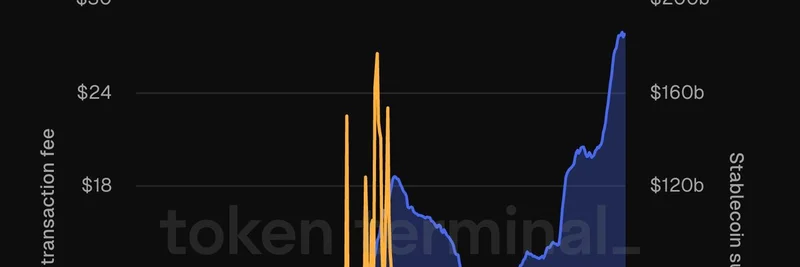
At the heart of Token Terminal's insight is a dual-line graph tracking two key metrics from early 2018 through late 2025: Ethereum's median transaction fee (in orange) and the total stablecoin supply on the network (in blue).
< Image src="https://pbs.twimg.com/media/G7lEsbOWkAE377Z.jpg" alt="Chart showing Ethereum median transaction fee vs stablecoin supply from 2018 to 2025, highlighting fee drop to under $1 and supply growth to over $150B" width={800} height={450} />
What jumps out immediately? Those wild fee spikes in 2021—peaking above $24 during the bull run's frenzy—have given way to a steady decline. By mid-2025, fees have bottomed out at a mere $0.01 per transaction. Meanwhile, stablecoin supply tells the opposite tale: a meteoric rise from near-zero in 2018 to over $150 billion today. It's no coincidence. As fees fall, more capital flows in, creating a virtuous cycle for low-risk DeFi protocols like lending platforms and yield farms that prioritize stability over high-volatility trades.
For the uninitiated, stablecoins—think USDT, USDC, or DAI—are cryptocurrencies pegged 1:1 to fiat like the U.S. dollar. They're the "safe money" of crypto, enabling users to park funds without the rollercoaster of Bitcoin or meme token swings. When their supply balloons on Ethereum, it means everyday users and institutions are betting big on ETH's infrastructure for everything from cross-border payments to automated savings.
Why $0.01 Fees Change Everything
Token Terminal's accompanying caption nails it: "moving $1 on Ethereum costs $0.01, moving $1 million costs $0.01, moving $10 billion costs $0.01." This fixed-cost model is the secret sauce of a "new financial rail"—a term borrowed from traditional finance to describe high-throughput, low-friction systems that can handle global scale.
In practical terms:
- For Retail Users: Swapping $50 for coffee via a DeFi wallet? Pennies in fees make it viable, not punitive.
- For Institutions: Transferring millions in stablecoins for treasury management? Ethereum now rivals legacy systems like SWIFT, minus the intermediaries and delays.
- For DeFi Builders: Lower barriers mean more innovation in low-risk apps, from tokenized real-world assets to automated market makers (AMMs) focused on stability.
This isn't just theory. Layer 2 solutions like Optimism and Arbitrum, built atop Ethereum, have slashed costs by bundling transactions off the main chain while inheriting its security. The result? A user experience (UX) that's finally "good enough" to lure in the masses, as the chart's subtitle teases: "Ethereum is improving the UX for low-risk DeFi."
Tying It to the Meme Token World
At Meme Insider, we're all about the wild side of tokens—the Dogecoins and PEPEs that capture cultural lightning in a bottle. But even meme enthusiasts can't ignore the foundational shifts happening underneath. As Ethereum's fees stabilize, it's easier than ever to bridge meme gains into low-risk DeFi plays. Imagine cashing out a viral pump into a stablecoin yield strategy without losing half to gas wars. This efficiency could fuel the next wave of meme token liquidity, blending high-risk speculation with Ethereum's battle-tested rails.
What's Next for Ethereum's Financial Revolution?
The data suggests we're at an inflection point. With stablecoin supply still climbing and fees at historic lows, Ethereum isn't just surviving—it's thriving as the go-to layer for programmable money. Watch for increased institutional inflows via BlackRock's tokenized funds or more DeFi primitives integrating real-world data oracles for ultra-low-risk yields.
If you're a blockchain practitioner dipping into DeFi, now's the time to experiment. Tools like MetaMask paired with L2 explorers can get you started fee-free. And for meme token holders? This is your cue to diversify without the burn.
Stay tuned to Meme Insider for more breakdowns on how macro crypto trends intersect with the fun stuff. What's your take on Ethereum's fee renaissance—bullish for memes, or just another layer in the stack? Drop your thoughts below.
Data sourced from Token Terminal's on-chain analytics as of December 2025.