Meme Insider
It's Fusaka week, folks – that exciting time when Ethereum pushes the boundaries of scalability once again. If you're knee-deep in the world of blockchain like we are at Meme Insider, you've probably heard the buzz around PeerDAS. But what happens when the theory meets the mainnet? Enter the brand-new live custody monitoring dashboard, straight from the labs of ethPandaOps and the Ethereum Foundation's P2P team. This tool isn't just a shiny interface; it's a real-time watchdog for data availability, asking the tough question: Are Ethereum nodes actually holding up their end of the bargain?
Let's break it down simply, because not everyone lives and breathes EIPs (Ethereum Improvement Proposals) day in and day out. PeerDAS, or Peer Data Availability Sampling, is the star feature of the upcoming Fusaka hard fork. Think of Ethereum's data availability layer as the backbone that keeps blobs – those chunky data packets for rollups and layer-2 solutions – accessible to everyone without bogging down the network. Before PeerDAS, every node had to store every single blob, which is like asking every library in the world to stock identical copies of every book. It's inefficient and doesn't scale as Ethereum grows.
PeerDAS flips the script with smart sampling. Blob data gets erasure-coded for redundancy (basically, shredded into pieces with backups built-in) and split into 128 columns. Nodes don't hoard the whole thing; instead, they commit to subsets based on their identity and validator balance. Need the full picture? Just 64 distinct columns from different nodes reconstruct it perfectly. This slashes storage demands and supercharges scalability – we're talking dramatic improvements for high-throughput apps, from DeFi to those viral meme token launches we love tracking.
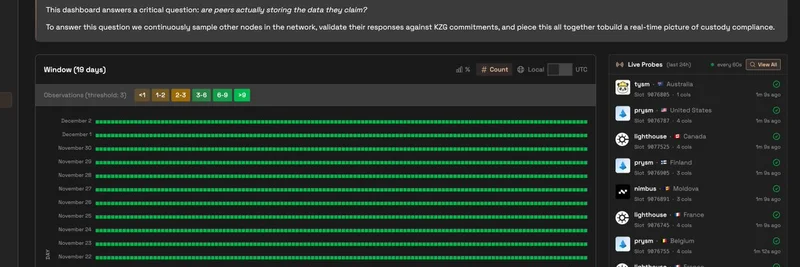
But here's the kicker: commitments are easy to make, but follow-through? That's where trust breaks down. The new dashboard steps in as the ultimate verifier. It continuously samples other nodes, cross-checks their responses against KZG commitments (those cryptographic proofs that ensure data integrity), and paints a live snapshot of custody compliance. Green lights for compliant nodes, flags for slackers – all in real-time. No more blind faith in the network; this is transparency on steroids.
From the dashboard's view (check out that screenshot above), you can see observations over a 19-day window, with color-coded bars showing how many columns nodes are actually custodying. Prysm, Lighthouse, Nimbus – the big clients are all in the mix, hailing from Australia to Romania. It's a global relay race for data, and this tool ensures no one's dropping the baton. Imagine the peace of mind for stakers and developers: Your validators aren't just participating; they're proving it.
Why does this matter for the meme coin crowd and blockchain builders? In a world where speed and reliability fuel the next Dogecoin-inspired frenzy, Ethereum's ability to handle massive data without hiccups is gold. PeerDAS isn't just tech jargon; it's the enabler for cheaper, faster L2 transactions that could spark the next meme token supercycle. Plus, with the Ethereum Foundation's P2P team in the collab, you know it's battle-tested.
As Fusaka rolls out post-mainnet, keep an eye on this dashboard – it's your window into a more robust Ethereum. Got thoughts on how PeerDAS could amp up meme token ecosystems? Drop 'em in the comments. We're all ears (and pandas) here at Meme Insider, curating the freshest insights to level up your blockchain game. Stay tuned for more on the Fusaka frontier.