Meme Insider
In the fast-evolving world of decentralized AI, Bittensor (often known by its token TAO) is making waves by creating a marketplace for intelligence. This isn't just about humans trading data—it's opening doors for robots and AI agents to buy the information they need on the fly. A recent thread from @0xSammy on X highlights how Bittensor's subnets could plug directly into the emerging machine economy, and it's got the crypto community buzzing.
Robotics is on the cusp of explosive growth, demanding huge amounts of multi-modal data—like images, videos, and sensor readings—along with constant fine-tuning to adapt to real-world scenarios. Bittensor steps in here as a decentralized network where validators and miners contribute compute power and data, earning TAO rewards. Subnets are specialized mini-networks within Bittensor, each focusing on a niche area of AI or data processing. Think of them as app-specific layers that enhance the overall ecosystem.
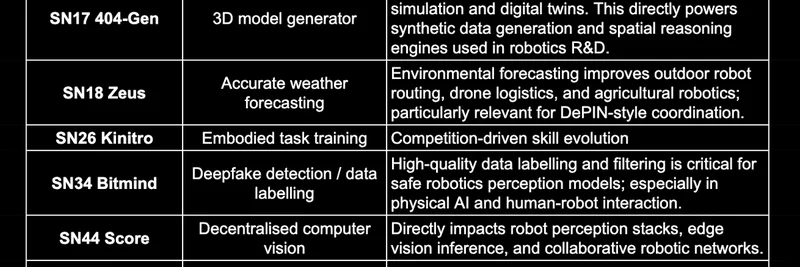
In the thread, @0xSammy maps out several subnets and their potential impact on robotics. Here's a breakdown of that insightful table:
SN3 Templar: Focuses on distributed decentralized pre-training. This could make training robot perception, control, and planning models across nodes cheaper and faster, key for scaling humanoid robots or fleets.
SN13 Data Universe: A decentralized data scraper that enables robots to access massive datasets for learning about the world. It's crucial for synthetic and real-world training inputs, helping with navigation, grasping, and even language grounding.
SN17 404-Gen: Generates 3D models, powering simulation systems and digital twins. In robotics R&D, this spatial reasoning is vital for testing environments virtually before deploying in the physical world.
SN18 Zeus: Provides accurate weather forecasting, which improves outdoor robot operations like drone logistics or agricultural bots. It's particularly relevant for DePIN-style coordination (Decentralized Physical Infrastructure Networks).
SN26 Kintro: Handles embodied task training, driving competition in skill evolution. High-quality data labeling and filtering are critical for physical AI and human-robot interaction.
SN34 Bitmind: Deepfake detection and data labeling ensure reliable inputs for robot perception models.
SN44 Score: Decentralized computer vision that impacts robot perception stacks, edge vision inference, and collaborative networks.
SN47 Reboot: A robotic AI marketplace for training, deployment, and service brokers.
SN56 Gradients: Auto ML for one-click training pipelines, useful for robotic control loops and reinforcement learning in physical settings.
SN62 Ridges: Open-source coding assistant that accelerates development of robotic firmware and simulation frameworks.
SN72 StreetVision: Street-level perception for mapping, navigation, and autonomous driving.
SN93 Bitcast: Video generation agency aiding synthetic video generation, data augmentation, and multimodal pre-training.
SN124 Swarm: Autonomous drone flight for distributed autopilot systems.
This mapping shows how Bittensor isn't just theoretical—it's building infrastructure that robots could tap into for real-time needs. With subnet tokens now tradable on Base (an Ethereum Layer 2 known for its low fees and meme coin frenzy), and protocols like x402 enabling trillions of agentic micropayments, we're seeing the groundwork for machines to transact independently.
The thread also quotes an earlier post from @0xSammy about a robotics podcast, emphasizing that robotics will dwarf AI adoption over the long term. Households might spend more on embodied AI than cars, reshaping cities and workforces. It's a multi-decade play with asymmetric upside, where costs plummet, enabling universal healthcare and more.
For meme token enthusiasts, this is intriguing because subnet tokens could spark speculative trading similar to how Base has fueled meme coin mania. As agents and robots start "purchasing" data via these rails, we might see viral narratives around specific subnets, turning them into the next hot crypto plays.
What's missing? Subnets for sensory data, real-time logistics, or even maintenance prediction could further fuel this economy. If you're in blockchain or AI, keeping an eye on Bittensor's evolution could pay off big time. For more on decentralized AI trends, check out resources like the Bittensor docs or follow key voices on X.
This blend of AI, robotics, and crypto is set to transform how we think about value exchange—not just between people, but between machines.