 Meme Insider
Imagine a world where your stablecoins aren't locked into one blockchain or one currency—they flow freely across networks and borders, powering everything from everyday payments to DeFi strategies. That's not some distant sci-fi vision; it's happening right now, and the spotlight is on JPYC, Japan's yen-pegged stablecoin that's making waves on Polygon.
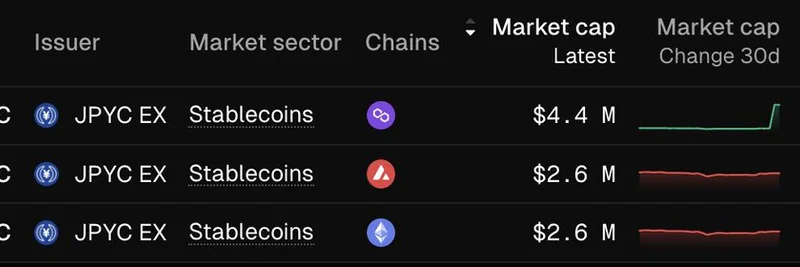
In a recent update from Token Terminal, the data wizards behind crypto fundamentals, they dropped a chart that's got the blockchain community buzzing. It shows JPYC leading the pack in market cap among stablecoins on Polygon, clocking in at a hefty $4.4 million with a jaw-dropping 70.3% surge over the last 30 days. Trailing behind are other JPYC variants on Arbitrum and Ethereum, both hovering at $2.6 million but with flat or slightly negative growth.
This isn't just numbers on a screen—it's a snapshot of a seismic shift. JPYC's supply is ballooning fastest on Polygon, Ethereum's go-to layer-2 for speed and low fees. Why Polygon? Simple: it's scalable, cost-effective, and increasingly the home for real-world asset integrations. For Japanese users, this means seamless, affordable ways to bridge fiat-like stability with crypto's global reach.
But let's break it down for the uninitiated. Stablecoins like JPYC are digital tokens backed 1:1 by actual yen, designed to hold steady value amid crypto's wild rides. They're the bridge between traditional finance and blockchain, perfect for remittances, trading, or even earning yield without the volatility headache. JPYC, launched by JPYC Inc., has been a pioneer in this space since 2021, focusing on empowering Japan's massive economy—think the world's third-largest—with crypto tools.
The multichain angle? That's where things get exciting. No longer are we chained (pun intended) to Ethereum's high gas fees or slow confirmations. Projects like JPYC are deploying across ecosystems: Polygon for efficiency, Arbitrum for optimistic rollups, and Ethereum for that battle-tested security. Token Terminal's chart highlights this fragmentation-turned-strength—each chain brings its flavor, from Polygon's zk-tech upgrades to Arbitrum's developer-friendly vibe.
So, what does this mean for you, the blockchain practitioner dipping toes into meme tokens or eyeing stablecoin plays? First off, diversification is key. As supply grows on Polygon, expect more liquidity pools, better swap rates, and integrations with hot DeFi protocols. It's a boon for cross-border payments too—imagine sending yen-stable value to Southeast Asia without the usual forex gouge.
Critics might point out the "fragmented" landscape, as one reply noted, but that's the beauty of it. This isn't chaos; it's evolution. Data from Token Terminal shows JPYC's Polygon dominance isn't a fluke—it's fueled by partnerships, like those with Japanese Web3 wallets and NFT marketplaces. And with global stablecoin regs tightening (hello, MiCA in Europe), yen-backed options like JPYC offer a compliant, localized alternative to USD giants like USDT or USDC.
Looking ahead, this multichain, multicurrency push could supercharge adoption in Asia. Japan's already ahead with its crypto-friendly policies—remember the 2023 stablecoin laws?—and JPYC is riding that wave. For meme token hunters at Meme Insider, keep an eye on how these stables interplay with viral projects; stable liquidity often fuels the next big pump.
In short, JPYC on Polygon isn't just growing—it's proving the future is here, multichain and all. Whether you're a trader, builder, or just curious, this is your cue to explore. What's your take—ready to yen in on the action? Drop your thoughts below, and stay tuned for more deep dives into the tokens shaping tomorrow.