 Meme Insider
Ever had that sinking feeling when you check your wallet after a quick Solana swap and see fees that don't add up? You're not alone. If you're trading on Jupiter Exchange, the go-to DEX aggregator on Solana, you might be getting hit with unexpected platform charges. The culprit? Shady browser extensions hijacking your trades.
In a recent X post, Aaron from Jupiter's engineering team dropped a public service announcement that's got the crypto community buzzing. "🚨PSA: check your installed extensions!!!" he wrote, highlighting how these sneaky add-ons are inflating fees without your knowledge. It's a timely reminder in the wild world of meme tokens and high-volatility trades, where every satoshi counts.
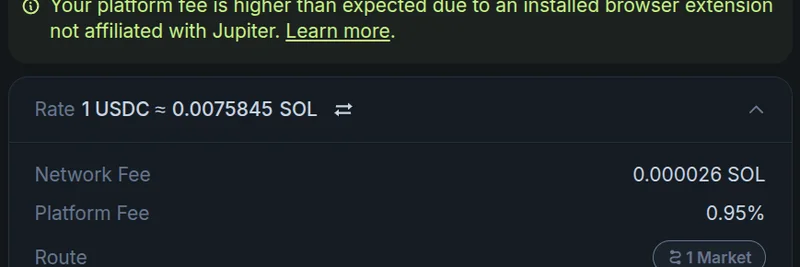
Take a look at the screenshot Aaron shared. What looks like a standard USDC to SOL swap (at a rate of 1 USDC = 0.0075845 SOL) should only ding you for a tiny network fee of 0.000026 SOL. But nope—there's a whopping 0.95% "platform fee" tacked on, routed through "1 market." And that yellow warning banner? "Your platform fee is higher than expected due to an installed browser extension not affiliated with Jupiter." Ouch.
These aren't legit tools from Jupiter. They're rogue extensions like Kerberus and Pocket Universe, which users in the thread quickly called out. As Aaron clarified in replies, the full list is updated in Jupiter's official support article. These bad actors inject themselves into your browser, intercepting swaps to skim extra fees—think of it as a digital pickpocket working the DeFi crowds.
Why does this hit home for meme token traders? Solana's ecosystem is meme central right now, with tokens like $BONK, $WIF, and fresh pumps flying left and right. You're zipping through Jupiter for the best routes on low-liquidity pairs, chasing that next 10x. But if extensions are quietly draining 1% here and there, it adds up fast—especially on small trades where you're flipping for quick gains. One user in the thread quipped, "Damn you should always keep wallets away from other installed extensions, clean browser kinda thing." Spot on.
So, how do you stay "safu," as Aaron puts it? Here's your quick checklist:
Audit your extensions: Head to your browser's add-ons page (Chrome: chrome://extensions/). Hunt for anything unfamiliar, especially those promising "wallet enhancements" or "trade optimizers." Kerberus and Pocket Universe are the known villains—nuke 'em immediately.
Verify fees pre-swap: Before confirming any trade on Jupiter, eyeball that fee breakdown. Network fees on Solana are dirt cheap (often under 0.01 SOL). Anything labeled "platform fee" over 0%? Red flag. Jupiter itself doesn't charge platform fees—it's all about optimal routing.
Use incognito or a clean profile: As one commenter suggested, "god bless incognito." Trading in a fresh browser window sidesteps persistent extensions. Pro tip: Pair it with a hardware wallet like Ledger for that extra layer of security.
Stay updated: Bookmark Jupiter's security hub and follow @JupiterExchange on X. They're on top of these threats, and quick PSAs like this one keep the community one step ahead.
This isn't just a Jupiter problem—it's a broader wake-up call for Solana users knee-deep in the meme token frenzy. With billions in TVL flowing through aggregators like Jupiter, scammers are always evolving. But knowledge is your best defense. Next time you're hunting that viral cat coin or dog-themed gem, double-check those extensions. Your portfolio will thank you.
If you've dodged a bullet (or gotten burned) by one of these extensions, drop your story in the comments. Let's build that shared intel to keep the Solana meme meta thriving—safely. What's your go-to setup for secure swaps?