Meme Insider
Last week, the crypto markets took a hit, with Solana's SOL token dropping 14% from $142 to $122 between November 19 and 21. This kind of volatility isn't new in the world of blockchain, but it's always a test for DeFi protocols. Enter Kamino Lend, a popular lending platform on Solana, which handled the storm like a champ. According to a detailed thread from Allez Labs, the team behind Kamino's risk management, the protocol processed $5.5 million in liquidations across over 4,000 events—without incurring any bad debt. That's a big deal, especially for meme token enthusiasts who often leverage positions in this ecosystem.
For those new to the terms, DeFi stands for Decentralized Finance, which includes lending and borrowing crypto assets without traditional banks. Liquidations happen when borrowed positions become undercollateralized due to price drops, forcing the protocol to sell off collateral to repay loans. Bad debt occurs if the system can't recover the full loan amount, which can spell trouble for the entire platform.
In this case, Kamino Lend's risk engine shone through. The median user loss was a tiny 0.08% of their position size—meaning most people who got liquidated barely felt the pinch. This is thanks to partial liquidations, where only a portion of the position is sold off, giving users a chance to recover without losing everything.
The event unfolded gradually at first, with light liquidations on November 19 and 20. Then, on the 21st, things ramped up: 89% of all liquidations happened that day, peaking at 1,523 in a single hour as SOL plummeted. Despite the intensity, the system held up.
Breaking down the numbers, the collateral seized was mostly in liquid assets: SOL made up 51.7% ($2.85M), followed by JLP (Jupiter Liquidity Provider tokens) at 20.7% ($1.14M), and others like cbBTC and xBTC. On the debt side, USDC dominated at 82.4% ($4.50M). This focus on deep liquidity pools ensured smooth operations during the stress.
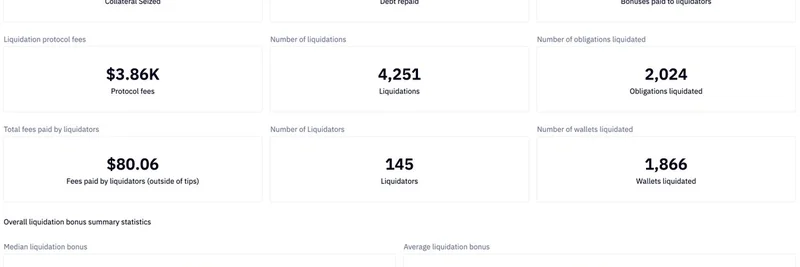
Liquidations were concentrated in the main market (75%), with JLP at 21%, showing the protocol directed flow to where liquidity was strongest. About 1,866 wallets were affected, but with such low median losses, it was more of a nudge than a knockout.
A growing network of 145 liquidators participated—up from 114 in October—indicating better decentralization and efficiency. The top five wallets accounted for 43.5% of liquidations, but most were under $100k, and only three exceeded $200k.
Compared to a similar event in October, this one was smaller ($5.5M vs. $20M), even though the SOL drop was comparable. It suggests users are getting smarter about risk management, positioning more conservatively after previous lessons.
Transaction volumes stayed balanced at $3.7 billion, with equal deposits and withdrawals, pointing to orderly deleveraging rather than panic. Solana's network performed flawlessly, handling all those transactions without congestion or fee spikes—highlighting its edge in high-throughput scenarios.
Marius from Kamino (@y2kappa) chimed in on the thread, noting the delicacy of touting "no bad debt" amid ongoing DeFi stresses but emphasizing the importance of building a solid track record. A reply from @TheWhiteWhaleV2 appreciated the sensitivity, referencing broader discussions on fixing DeFi issues.
So, why does this matter for meme tokens? Solana is the hotspot for meme coin mania, with tokens like those pumped on platforms such as Pump.fun relying on the chain's speed and low fees. Many meme traders use DeFi lending like Kamino to leverage their bets—borrowing against holdings to amplify gains (or losses). Events like this deleveraging can cascade into meme markets, forcing liquidations that dump tokens and heighten volatility. But Kamino's resilience means fewer forced sells, potentially stabilizing the ecosystem for meme projects. It shows Solana DeFi maturing, which could attract more capital to meme-friendly liquidity pools.
For more in-depth data, check out the Kamino liquidation dashboard from Allez Labs.
In the wild world of memes and crypto, staying informed on these backend mechanics can give you an edge. What do you think—will this build more confidence in Solana-based lending for meme strategies? Share your thoughts!