 Meme Insider
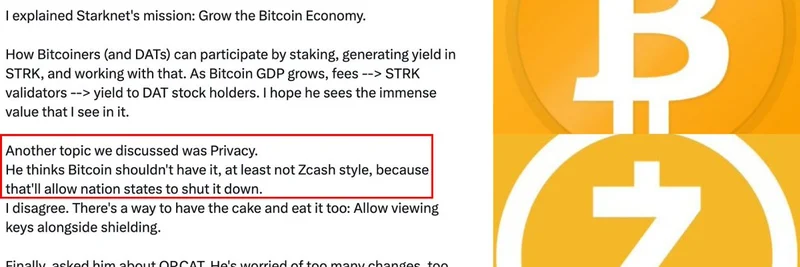
A recent tweet from Eli Ben-Sasson, co-founder of Zcash and president of StarkWare (the team behind Starknet), has sparked discussions in the crypto community. Ben-Sasson recounted his first in-person conversation with MicroStrategy's Michael Saylor, highlighting key differences in their visions for Bitcoin.
In the chat, Ben-Sasson explained Starknet's mission: growing the Bitcoin economy. He described how Bitcoin holders, including those with wrapped BTC (often called DATs in this context), can participate by staking, generating yield in STRK tokens, and benefiting from the ecosystem. As Bitcoin's "GDP" grows through fees, those fees flow to STRK validators, who then provide yield back to DAT holders. It's a clever loop designed to align incentives and expand Bitcoin's utility.
But the real headline-grabber was their disagreement on privacy. Saylor reportedly believes Bitcoin shouldn't have strong privacy features—at least not Zcash-style shielded transactions—because full anonymity could give nation-states an excuse to crack down on the network entirely.
Ben-Sasson pushed back, arguing it's possible to "have your cake and eat it too." He advocates for optional viewing keys alongside robust shielding, allowing users to prove transactions or ownership without exposing everything. This balanced approach could preserve privacy for those who need it while maintaining transparency where required.
They also touched on OP_CAT, a proposed Bitcoin opcode that would enable more advanced scripting. Saylor expressed concerns about rushing too many changes, fearing it could destabilize the network. Ben-Sasson disagreed, noting that OP_CAT has been thoroughly debated and researched for over a decade—no need for centuries of deliberation.
The conversation didn't cover quantum resistance, which Ben-Sasson saved for a future discussion.
This exchange underscores a longstanding debate in Bitcoin circles: transparency for regulatory acceptance and institutional adoption (Saylor's camp) versus built-in privacy to protect users from surveillance (echoing cypherpunk roots, as in Zcash).
With Starknet actively working to become a Layer 2 for Bitcoin—leveraging zero-knowledge proofs for scalability and potential privacy—Ben-Sasson's perspective carries weight. Starknet aims to bring faster, cheaper transactions to BTC while exploring enhancements like those enabled by OP_CAT.
Whether Bitcoin evolves toward more privacy or sticks to its transparent ledger remains a hot topic. What do you think—should Bitcoin prioritize unshielded transparency to avoid regulatory backlash, or build in optional privacy tools? The community's divide could shape the network's future.