 Meme Insider
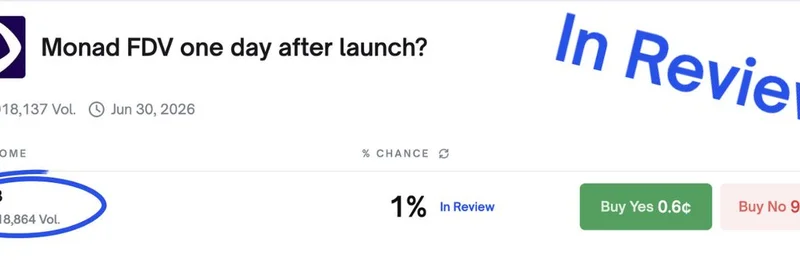
In the fast-paced world of crypto, prediction markets like Polymarket often capture the excitement and uncertainty around new token launches. Recently, a tweet from DeFi enthusiast @FabianoSolana highlighted a brewing storm over a market betting on whether Monad's fully diluted valuation (FDV)—that's the total value of all tokens if fully circulated—would top $4 billion just one day after its launch.
The drama stems from conflicting prices across exchanges. On Coinbase, MON traded at around $0.039, while Upbit showed $0.041. This small difference might seem minor, but in a high-stakes bet with millions in volume, it could decide fortunes. The original market rules pointed to "the most liquid price source available" as the decider, without naming specifics like Coinbase or limiting to USD pairs.
Things got messy when Upbit, a major Korean exchange, dominated the global spot volume for MON at the key timestamp. Yet, after trading kicked off and positions were locked in, Polymarket clarified Coinbase as the source. Now, with the market in review and over $10 million in volume at stake, debates rage over what "liquid" really means—actual traded volume, slippage potential, or even KRW-to-USD conversions.
Data from sources like CoinMarketCap apparently crowns Coinbase as the liquidity king, but traders argue Upbit's real-world volume tells a different story. This isn't just nitpicking; it's a real test for prediction markets' reliability in crypto, where borderless trading meets varying regulations and market depths.
Why This Matters for Crypto Enthusiasts
For anyone diving into DeFi or meme tokens, prediction markets offer a way to gauge hype and sentiment. Monad, as a promising blockchain project aiming for high-performance execution, drew massive attention. But incidents like this expose vulnerabilities: ambiguous rules can lead to disputes, eroding trust.
Traders betting big—some potentially losing hundreds of thousands—now wait on Polymarket's resolution. Replies to the tweet echo the frustration, with users calling it a "hunger games" scenario and stressing the need for ironclad oracle rules upfront.
Lessons for Future Bets
This saga underscores the importance of clear definitions in prediction markets. Whether it's specifying exact exchanges, currency pairs, or liquidity metrics, ambiguity invites chaos. For blockchain practitioners, it's a reminder to scrutinize market terms before jumping in, especially amid volatile launches.
As meme tokens and major projects alike fuel these bets, platforms like Polymarket must evolve to handle global disparities. Keep an eye on this one—it could set precedents for how crypto predictions are settled moving forward.