Meme Insider
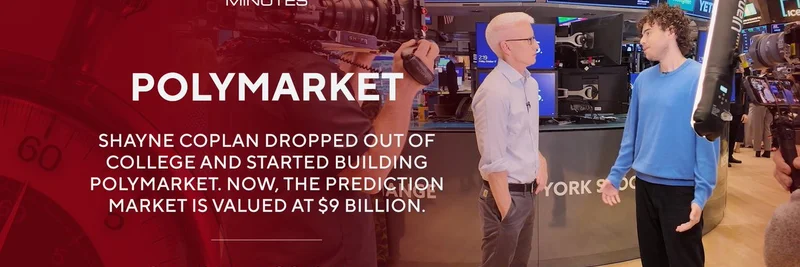
The buzz around Polymarket just hit mainstream TV. In a recent tweet from 60 Minutes, they teased an upcoming segment on Shayne Coplan, the Gen Z founder who dropped out of college to build what’s now a $9 billion prediction market powerhouse. Anderson Cooper is set to dive into Coplan’s story this Sunday, highlighting how a bathroom-turned-office idea evolved into a billion-dollar empire.
If you’re deep into meme tokens, this isn’t just another crypto success story—it’s a game-changer for how we gauge market sentiment and predict trends in the wild world of blockchain.
Who Is Shayne Coplan and How Did Polymarket Start?
Shayne Coplan, born in 1998, grew up in New York City and showed an early knack for tech and crypto. At just 14, he was tinkering with cryptocurrency mining farms. By 16, he jumped into Ethereum’s initial coin offering, snagging ETH at rock-bottom prices. He enrolled in computer science at NYU but ditched the degree to chase bigger dreams in crypto.
Fast-forward to 2020: With funds running low and working from his improvised bathroom office in a Lower East Side apartment, Coplan launched Polymarket. Inspired by economists like Friedrich Hayek, who championed decentralized info systems, Polymarket lets users bet on real-world outcomes using cryptocurrency. It’s built on the Polygon blockchain and uses USDC stablecoins for trades, making it accessible and secure for crypto natives.
Early hurdles? Plenty. In 2022, the U.S. Commodity Futures Trading Commission (CFTC) slapped Polymarket with a $1.4 million fine for operating without proper registration, forcing it to block U.S. users temporarily. But Coplan pivoted, and by 2025, things turned around. A regulatory thaw under new administration policies, plus a massive $2 billion investment from Intercontinental Exchange (ICE)—the parent of the New York Stock Exchange—catapulted Polymarket’s valuation to $9 billion. That deal made Coplan the world’s youngest self-made billionaire at 27, with an estimated $1 billion net worth from his 11% stake.
Other big-name backers? Think Peter Thiel’s Founders Fund, Vitalik Buterin, Joe Gebbia from Airbnb, and even Red Hot Chili Peppers’ Anthony Kiedis. It’s a who’s who of tech and finance betting on prediction markets as the future.
What Makes Polymarket Tick?
At its core, Polymarket is a prediction market platform where you buy and sell shares in event outcomes. Shares are priced between 0 and 1 USDC, reflecting the probability of something happening. For example, if a “Yes” share for an event trades at 0.60 USDC, the market sees a 60% chance of it occurring. When the event resolves, winners get 1 USDC per share, losers get nothing—it’s fully collateralized.
Why is this better than polls or expert opinions? Prediction markets aggregate collective wisdom through real stakes. Studies show they’re often more accurate because people put their money where their mouth is. Polymarket covers everything: politics, sports, entertainment, economics, and yes—crypto.
The Meme Token Connection: Betting on the Unpredictable
Here’s where it gets exciting for meme token enthusiasts. Meme coins like Dogecoin, Shiba Inu, or the latest Solana pumps thrive on hype, celebrity tweets, and viral moments. Polymarket lets you bet on these exact triggers, turning gut feelings into profitable insights.
Take a look at their crypto category—markets on Bitcoin prices, Ethereum upgrades, or even “Will Trump post about a memecoin before the election?” (Spoiler: There was a market for that, tapping into the chaotic energy of political memes crossing into crypto.)
Platforms like Pump.fun, the Solana meme coin launcher, have their own Polymarket bets too. One recent market wagered on whether Pump.fun would hit an all-time high this year, with odds split 50/50 amid fears of a crash. Median hold times for Solana memes are down to seconds, dominated by bots, but Polymarket gives traders a way to hedge or speculate on broader trends without diving into the frenzy.
And whispers of a native POLY token? Coplan has teased it, which could add another layer of meme-like speculation. If launched, it might become a hot token itself, blending utility with community hype.
For blockchain practitioners, Polymarket isn’t just gambling—it’s a knowledge base. By tracking market odds, you can spot emerging meme trends early. Say a market surges on a celebrity endorsement rumor; that’s your cue to investigate and position in related tokens. It’s like having a crystal ball powered by crowd intelligence.
Why This Matters for the Future of Crypto
Coplan’s rise from dropout to billionaire underscores a shift: Prediction markets are going mainstream. With ICE’s backing, Polymarket is eyeing tokenization initiatives and wider data distribution. For meme token fans, this means more accurate forecasts on volatile assets, helping you navigate pumps and dumps smarter.
As regulations evolve—note the recent CFTC probe closure and Trump Jr.’s advisory role—platforms like this could integrate deeper into traditional finance. But watch out: Not all regions are on board; Switzerland recently blocklisted Polymarket over gambling concerns.
If you’re building or trading in the meme space, keep an eye on Polymarket. It’s not just predicting the future—it’s shaping how we understand meme-driven markets. Tune into 60 Minutes for the full scoop, and maybe place a bet on what’s next.