 Meme Insider
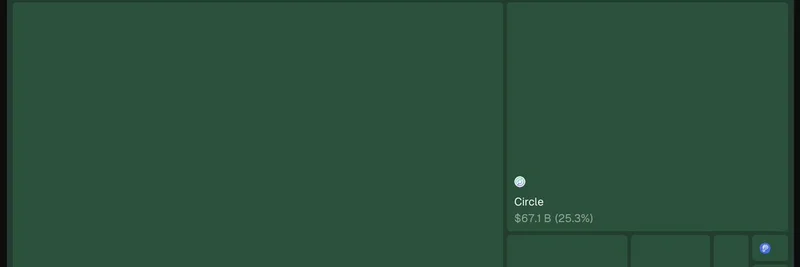
Have you ever wondered why a handful of players seem to dominate entire markets in crypto? Token Terminal, a leading crypto analytics platform, recently shared a striking visualization on X (formerly Twitter) that perfectly illustrates the power law at work in the stablecoin sector. Titled simply "Power law visualized," the chart breaks down the outstanding supply of stablecoins over the last 24 hours, showing just how skewed the distribution is.
What the Chart Reveals
At first glance, the treemap-style graphic paints a clear picture of market concentration. Tether (USDT) towers over the competition with a whopping $168.7 billion in outstanding supply, accounting for 63.6% of the total. That's more than double the next biggest player, Circle's USDC, which sits at $67.1 billion or 25.3%. Further down, Ethena claims $12.9 billion (4.9%), Sky holds $8.6 billion (3.3%), and a smattering of smaller issuers make up the rest.
This isn't just random data—it's a textbook example of the power law, also known as the Pareto principle or the 80/20 rule. In simple terms, it describes how a small number of entities often control the majority of resources or outcomes. In crypto, we've seen this play out time and again, from Bitcoin's dominance in the overall market cap to a few exchanges handling most trading volume.
Why Stablecoins Matter to Meme Token Enthusiasts
You might be thinking, "Stablecoins are boring compared to wild meme tokens—why should I care?" Fair point, but hear me out. Stablecoins like USDT and USDC are the backbone of the crypto ecosystem, providing liquidity for trading everything from blue-chip assets to the latest meme coins. When Tether mints billions more, it often signals incoming capital that could fuel pumps in volatile sectors, including memes.
Think about it: Meme tokens thrive on hype, liquidity, and quick money flows. A dominant stablecoin like Tether makes it easier for traders to jump in and out of positions without fiat on-ramps. Plus, the power law applies directly to meme coins too. Just look at Dogecoin and Shiba Inu—they capture the lion's share of meme market cap, while thousands of others fight for scraps. Understanding these dynamics can help you spot opportunities early, whether it's a new stablecoin challenger or the next viral meme.
Broader Implications for Crypto
Token Terminal's data highlights ongoing trends in the stablecoin space. Tether's lead has been unshakeable for years, bolstered by its widespread use on exchanges and in DeFi protocols. Circle, backed by heavyweights like Coinbase, is pushing for more regulatory compliance, which could attract institutional money. Emerging players like Ethena, with its synthetic dollar approach, and Sky (formerly MakerDAO's rebrand) are innovating to grab market share.
But concentration comes with risks. If one issuer faces issues—like regulatory scrutiny or redemption runs—it could ripple through the entire market. Remember the TerraUSD collapse? It wiped out billions and shook confidence across crypto. Diversification might be key, but as the power law shows, the market naturally gravitates toward winners.
For blockchain practitioners, this visualization is a reminder to monitor supply metrics closely. Tools like Token Terminal offer real-time insights that can inform trading strategies or even inspire new projects. If you're building in the meme space, consider how stablecoin liquidity could integrate with your tokenomics for better adoption.
In the end, the power law isn't just a fancy concept—it's the reality shaping crypto's evolution. Keep an eye on these distributions, and you might just position yourself ahead of the curve. What do you think—will Tether's dominance last, or is a shake-up coming? Drop your thoughts in the comments!