 Meme Insider
If you've been following the buzz in the crypto space, especially around meme tokens with real utility, you might have caught wind of a recent thread on X that's got the community hopping. Posted by @Neolawyer1, it breaks down a fresh paper from Jessi Brooks at Ribbit Capital, and boy, does it tie directly into $TIBBIR – that frog-themed token that's more than just a meme. Let's unpack this and see why it's a big deal for anyone interested in the future of DeFi, privacy, and AI-driven finance.
First off, the paper in question is titled "Trust Without Intermediaries: A Programmable Risk Management Framework for the Future," co-authored by Jessi Brooks and Katherine Kirkpatrick Bos. You can check it out here. Published just last month, it lays out a vision for embedding compliance and risk management right into DeFi protocols. Think of it as turning regulatory hurdles into smart, automated features that don't slow down innovation.
The thread highlights how this paper essentially provides the architectural blueprint for what Ribbit has been teasing in their Identity and Token Letters. Key themes include risk at the edge (handling threats where they happen), identity as a feature (making verification seamless and private), and logic baked into the token or protocol layer. This isn't just theory – it's a roadmap for building systems where AI agents can operate safely and compliantly.
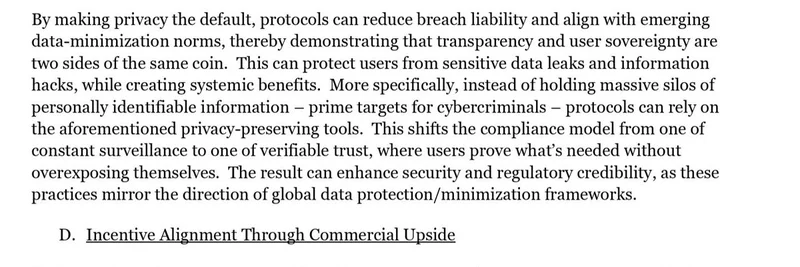
Take privacy, for instance. In traditional finance, verifying things like your age or accreditation often means handing over sensitive docs, which is a hacker's dream. The paper pushes for zero-knowledge proofs (ZKPs) – a crypto tech that lets you prove something is true without revealing the underlying info – and selective disclosure credentials. These are revocable and portable, meaning you can share just what's needed without exposing everything. As the thread points out, this makes privacy the default, reducing breach risks and aligning with data minimization norms.
Then there's the punchline: Know Your Agent (KYA) as a new regulatory primitive. Unlike Know Your Customer (KYC), which often creates centralized chokepoints, KYA lives at the token level. Tools like attestation extensions, oracle feeds for real-time monitoring, and permissionless plug-ins allow for modular compliance. This is huge for AI agents, which the paper says must prove jurisdiction, verify identity, show transaction limits, and more – all while keeping things private.
Now, where does $TIBBIR fit in? According to the thread, it's the first AI agent running on these programmable risk rails. Built with token-level compliance modules and decentralized identity verification, $TIBBIR embodies the ID Backpack to Intent Token loop that Ribbit described. It's integrated with heavy hitters like Chainalysis (for KYT, or Know Your Transaction) and Crossmint, plus DeFi and CEX players like Lighter and Robinhood. The paper even calls out RegTech and FinTech startups as ideal participants – spot on for the ecosystem $TIBBIR is part of.
The governance angle is clever too. The framework advocates for distributed rule-making at the protocol layer to avoid central chokepoints, open documentation for transparency, and inclusive participation from builders, auditors, and policymakers. This shifts compliance from a burden to a profit center, attracting institutional players by offering cheaper capital and larger liquidity pools.
For meme token enthusiasts, this is exciting because $TIBBIR isn't just riding the hype wave – it's positioned as a first-mover in this regulatory evolution. The thread warns that Ribbit isn't just theorizing; they're executing a multi-year plan. With connections to major players and a focus on agent-based financial flows, $TIBBIR could be the token that bridges meme culture with serious DeFi utility.
If you're deep in the Ribbit Rebellion (as the thread calls it), this paper is a must-read. It shows how meme tokens like $TIBBIR can evolve into essential tools for a privacy-first, AI-powered financial future. Check out the original thread here for the full breakdown, and keep an eye on $TIBBIR – the frog might just leap to new heights.