Meme Insider
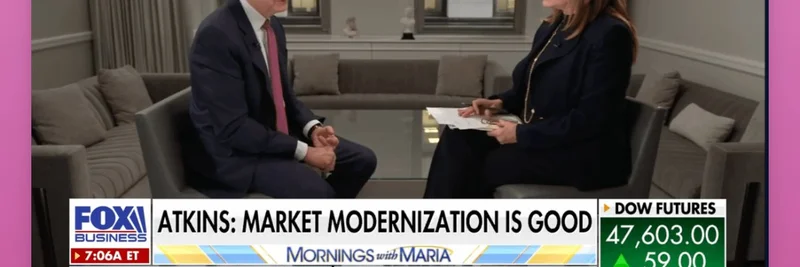
In the ever-evolving world of finance and blockchain, few voices carry as much weight as Paul Atkins, a seasoned SEC Commissioner with a track record of championing innovation. Recently, during a candid interview on Fox Business' Mornings with Maria, Atkins laid out a compelling case for tokenization—the process of converting real-world assets into digital tokens on a blockchain—as the linchpin for modernizing U.S. markets. Drawing from this insightful exchange, as highlighted in a viral thread by DeFi analyst Ignas (@DefiIgnas), let's unpack the key benefits Atkins touted and what they mean for the future of crypto and traditional finance.
Why Tokenization Matters: Atkins' Core Pitch
Atkins didn't mince words: tokenization isn't just a buzzword; it's a practical upgrade to a system that's creaky at best. Right now, companies issuing stocks often fly blind when it comes to understanding their shareholder base. Who exactly owns what? It's a black box riddled with intermediaries, leading to inefficiencies and blind spots. Enter on-chain tokenization, where every transaction and holding is recorded transparently on a public blockchain ledger.
"Transparency: Companies currently don't even know who owns their stocks. Onchain tokenization provides insight into holder dynamics," Atkins emphasized. Imagine issuers gaining real-time visibility into investor behavior—spotting trends, gauging sentiment, and even tailoring communications more effectively. For blockchain practitioners and DeFi enthusiasts, this is music to the ears: it's the kind of data-driven edge that could supercharge tokenomics in meme coins and beyond.
But Atkins didn't stop at visibility. He zeroed in on speed, a perennial pain point in legacy finance.
Instant Settlement: Slashing Risks and Wait Times
One of the biggest drags on traditional markets is settlement times. Under the current T+1 system (trade date plus one business day), there's a nerve-wracking gap between when a trade executes and when funds and assets actually change hands. This delay isn't just inconvenient—it's risky. Market volatility can turn a sure thing sour overnight, and the clearance process leaves room for errors or disputes.
Tokenization flips the script with instant settlement. On a blockchain, smart contracts automate the handover the moment conditions are met—no middlemen, no waiting. Atkins highlighted how this "de-risks the markets due to decreased gap between clearance and settlement, and then delivery and payment." In plain terms: trades clear faster, reducing counterparty risks and freeing up capital that would otherwise be tied up in limbo.
For those dipping their toes into meme tokens or high-volatility DeFi plays, this resonates deeply. We've all seen the chaos of delayed executions in centralized exchanges; blockchain's atomic swaps could make that a relic of the past. And as Atkins noted in response to host Maria Bartiromo's probing question—"Do you think this is where financial services are going? Are banks moving to tokenization?"—the answer is a resounding "Oh, absolutely." Banks aren't waiting for permission; they're piloting tokenized assets today, from BlackRock's tokenized funds to JPMorgan's blockchain experiments.
The Timeline: Not a Decade Away, But Just a Couple of Years
Here's where things get exciting (and maybe a tad urgent). Atkins dismissed the notion that widespread tokenization is some distant dream. "It's not happening in a decade. It's happening in a couple of years," he declared. With institutional players like Goldman Sachs and Fidelity already knee-deep in pilots, the infrastructure is aligning faster than skeptics might think. For the meme coin crowd, this could mean tokenized versions of viral assets hitting mainstream exchanges sooner, blending the fun of internet culture with the stability of regulated markets.
The Innovation Exception: A Regulatory Green Light for Crypto
Perhaps the juiciest nugget from Atkins' chat? The SEC's forthcoming "innovation exception." This isn't your run-of-the-mill policy tweak—it's a deliberate carve-out designed to let companies experiment with tokenized proof-of-concepts (POCs) without the suffocating legal scrutiny that's plagued crypto innovators for years. Think of it as a regulatory sandbox on steroids: test, iterate, and validate product-market fit (PMF) before full-scale launches.
In the past, bold ideas in DeFi or tokenized securities often hit a wall of enforcement actions, stifling growth. This exception could change that, fostering a wave of compliant yet creative projects. For meme token creators, it opens doors to hybrid models—fun, community-driven tokens backed by real-world utilities, all under a friendlier regulatory umbrella.
What This Means for Blockchain Builders and Meme Enthusiasts
As someone who's spent years at the intersection of crypto journalism and now curating insights at Meme Insider, I see Atkins' comments as a beacon. Tokenization isn't just about suits in boardrooms; it's a bridge to make blockchain accessible and efficient for everyone—from degens chasing the next Dogecoin moonshot to institutions seeking yield in tokenized treasuries.
If you're building in this space, keep an eye on the SEC's announcements. The innovation exception could be your ticket to experimenting without fear. And for those tracking meme tokens, watch how tokenization enhances liquidity and transparency—key to turning fleeting hype into sustainable value.
Paul Atkins' vision isn't pie-in-the-sky; it's grounded in the blockchain's core strengths. As markets evolve, staying informed on these shifts will be crucial. What's your take—will tokenization finally make meme coins go mainstream? Drop your thoughts in the comments, and subscribe for more deep dives into the wild world of tokenized finance.