 Meme Insider
Ever feel like the economy is booming on paper, but something just doesn't add up in real life? Wages lag behind prices, debt piles up, and everything seems a bit... off. Well, a recent thread on X (formerly Twitter) from macro thinker @The_Prophet_ dives deep into this disconnect, building on a chart shared by @LukeGromen. It's all about the "debasement trade" since COVID, and it might just change how you view your investments—especially in the crypto world.
Let's break it down simply. Debasement? That's when a currency loses value over time, often because governments print more money to cover debts or stimulate the economy. Think of it like diluting a drink—the more water you add, the weaker it gets. In the U.S., this has been happening big time post-2020, with trillions pumped into the system.
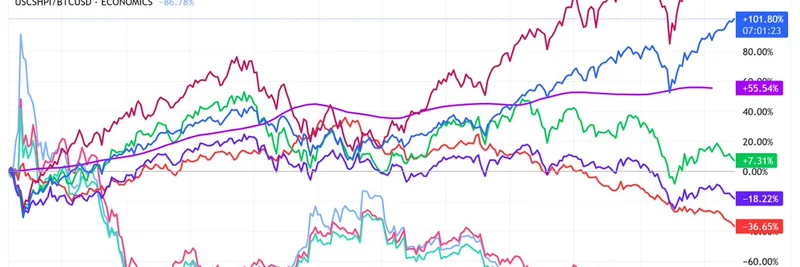
The chart in question compares asset performance in different "denominators"—basically, what yardstick you're using to measure value. In good old U.S. dollars (USD), things look rosy:
- Nasdaq (NDX) up about 165%
- S&P 500 (SPX) up 102%
- Home prices up 56%
Stocks are soaring, real estate is climbing—wealth for everyone, right? But switch the lens to gold, a traditional store of value that's not easily printed, and the picture shifts:
- NDX up just 7%
- SPX down 18%
- Homes down 37%
Stagnation city. Now, flip to Bitcoin (BTC), which many see as "digital gold" or even a new reserve asset, and it's a bloodbath:
- NDX down 78%
- SPX down 84%
- Homes down 87%
What @The_Prophet_ is highlighting here is a "unit-of-account fracture." In finance speak, a unit of account is how we measure value—like dollars for everyday stuff. But globally, that unit is cracking. In USD terms, we're in a boom; in harder assets like gold or BTC, it's a bust. This mirrors historical patterns before major currency shifts or hyperinflation, where people cling to the old money while the smart ones pivot to what's next.
He calls Bitcoin a "parallel reserve ledger," not just a risky tech play. Wall Street might label it volatile, but functionally, it's acting like a new benchmark in a "silent currency war." The U.S. is running an "imperial carry trade": attract global cash, inflate assets nominally, and export the inflation pain elsewhere. But measured in BTC, the old system's collapsing.
This thread sparked reactions, like from @DTAPCAP, who says it's accelerating a theme he's tracked since 2008. Others, like @olvelez007, called it the most powerful post of the year. And in a fun (or grim) reply, @iamterryhi dropped a Matrix meme implying if you don't own gold or Bitcoin, you're just a "battery" in the fiat system.
For us in the meme token space—and broader blockchain world—this is huge. Meme coins thrive on hype and community, but they're built on crypto rails. If BTC is emerging as a true alternative to fiat, it could supercharge the entire ecosystem. Think about it: as fiat debases, more capital flows into hard assets like BTC, and from there, into innovative (or fun) projects. But it also means volatility ahead as the old and new systems clash.
If you're holding meme tokens or any crypto, this isn't just macro noise—it's a signal to rethink your benchmarks. Are your gains real, or just USD illusions? As @The_Prophet_ puts it, we're in a "unit-of-account transition phase," and positioning early could be key.
Curious for more? Check the full thread here and join the conversation. In a world of melting ice cubes (that's fiat for you), hard money like BTC might just be the solid ground we need.