Meme Insider
In the fast-paced world of crypto, stablecoins are supposed to be the reliable anchors keeping things steady amid the volatility. But what happens when one starts trading above its $1 peg? That's exactly the buzz around USDai right now, as highlighted in a recent thread on X by @S4mmyEth. Let's break it down step by step, especially since this isn't your run-of-the-mill stablecoin—it's more like a synthetic dollar backed by high-tech AI hardware.
First off, USDai, created by the team at USDai Official, operates differently from traditional stables like USDC or USDT. Instead of just holding fiat or bonds, it overcollateralizes loans against AI GPUs (graphics processing units) at around 150% or more. This buffer helps maintain its peg to the dollar. Think of it as lending money secured by valuable tech assets that power AI computations—the kind big tech companies crave.
The thread kicks off by quoting an in-depth analysis from @PendleIntern, who dives into why USDai has depegged upward, meaning it's trading for more than $1 (around $1.06 at the time). Normally, you'd think buying $1 for more than $1 sounds crazy, but here's the twist: holding USDai earns you Allo Points, which add extra value. Plus, the minting caps are maxed out, so arbitrageurs can't flood the market with new USDai to bring the price back down. This disrupts the usual peg stability mechanisms, like those in a Peg Stability Module (PSM), where you'd mint and sell when prices are high.
@PendleIntern explains how this affects yields on platforms like Pendle, a DeFi protocol for trading yields. USDai's implied yield spiked to a whopping 51.6% APY (annual percentage yield), but that's priced in USDai terms. If you're swapping in from another stable like USDC, you risk losses if it repegs back to $1. On the flip side, early buyers of YT-USDai (yield tokens) are sitting pretty, benefiting from both the yield jump and the price depeg.
But @S4mmyEth adds a crucial cautionary note: while the upward depeg is exciting, understand the risks of a downward break. USDai's value ties into GPU valuations, which depend on future revenue from AI firms. If the "AI bubble" pops—say, companies cut back on GPU spending due to revenue shortfalls or alternatives—these assets could impair (lose value). Impairment happens when the net realizable value (what you could sell it for) or discounted cash flow (projected earnings) drops below book value. If that exceeds the overcollateralization buffer, boom—the peg breaks below $1.
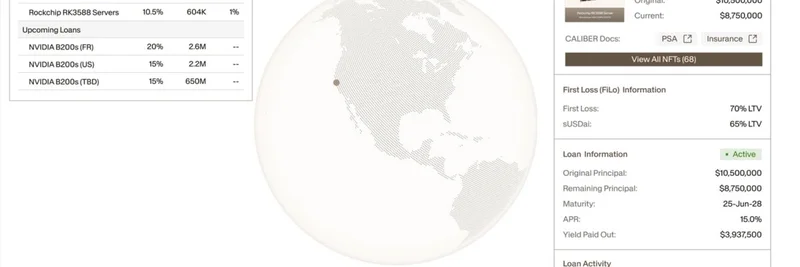
To illustrate, check out this screenshot from USDai's proof of reserves, showing their active and upcoming loans backed by assets like US T-Bills, RockChip servers, and NVIDIA B200 GPUs.
As you can see, 99% is currently in safe US T-Bills, but that's set to shift as more GPU loans roll out. @S4mmyEth points out the importance of monitoring AI headlines, GPU types in reserves, and audits (they've got KTL and Cantina on file). The team mitigates risks with short-dated loans and rapid principal repayments, effectively lowering loan-to-value (LTV) ratios over time—from 70% to around 45% after a year.
In a follow-up, @0xZergs from USDai chimes in, emphasizing due diligence and clarifying risks apply more to staked USDai (sUSDai). Replies from the community touch on everything from GPU market volatility to portfolio management, underscoring that while demand slowdown is a key concern, diversified assets could help.
So, if you're eyeing USDai for those juicy points or yields, bookmark this: it's a fascinating blend of DeFi and AI tech, but not without its pitfalls. Keep tabs on Big Tech's AI spending—trillions are at stake—and always DYOR (do your own research). In the meme token space, where hype meets utility, projects like this could inspire similar innovations, but remember, crypto's full of surprises. What's your take on GPU-backed stables?