 Meme Insider
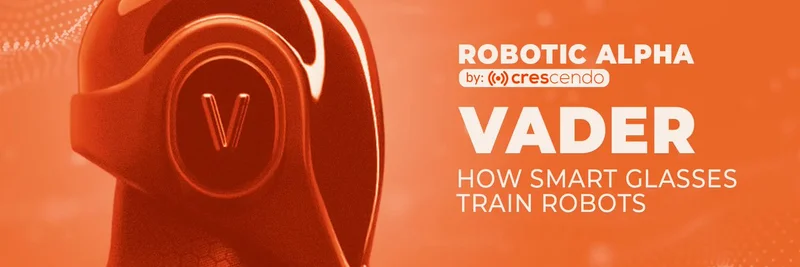
If you're into the wild world of meme tokens and cutting-edge tech, you've probably heard the buzz around $VADER. A recent thread on X from @crescendoweb3 highlighted a deep dive into Vader AI, and it's got the community talking. Written by @0xconglomerate, this breakdown shines a light on how Vader AI is tackling one of the biggest hurdles in robotics: getting clean, human-like data to train machines. Let's unpack this and see why $VADER might be more than just another meme coin.
The Robotics Data Dilemma
Embodied AI—think robots that can move, see, and interact like humans—needs tons of real-world data to learn. Traditional datasets often fall short because they're not from a first-person view, which is crucial for robots to understand tasks like folding clothes or pouring a drink. That's where Vader AI steps in, focusing on "egocentric video," or footage captured from the user's perspective. It's like giving robots a front-row seat to human life.
Unlike many projects that hype up futuristic robots, Vader AI zeros in on the foundation: data. As outlined in their litepaper, they're building a system to collect, process, and monetize this data, turning everyday actions into valuable training material.
EgoPlay: Gamified Data Collection
At the heart of Vader AI is EgoPlay, a platform that turns data gathering into a game. Users strap on smart glasses or use their smartphones to record simple tasks—cooking, cleaning, you name it. In return, they earn rewards. It's crowdsourcing on steroids, making it easy for anyone to contribute without feeling like it's work.
The beauty here is accessibility. You don't need fancy equipment; smart glasses make it "wear-and-forget." This first-person capture provides robots with authentic examples, helping them learn how to handle real-world variability, like different rooms or tools.
ORN: Turning Videos into Actionable Insights
Raw video is great, but robots need structured data to learn effectively. Enter ORN (likely standing for something like Observation-Response Network—though not explicitly defined, it's their proprietary AI tech). ORN processes the egocentric videos from EgoPlay, anonymizing them for privacy and converting them into reusable action sequences.
This step is key for generalization, meaning models trained on this data can adapt to new scenarios without starting from scratch. Plus, built-in safety features like red-team testing ensure no data leaks or misuse, which is crucial in a decentralized setup.
The Role of Smart Glasses in Training Robots
Smart glasses are the star hardware here. They capture high-quality, first-person views that smartphones might miss, like subtle hand movements or spatial awareness. Research shows this kind of data is gold for training robots, as seen in projects like EgoZero from tech labs. Vader AI leverages this to create datasets that bridge the gap between human intuition and machine learning.
Imagine walking around your home, glasses on, recording how you make coffee. That clip gets processed, anonymized, and fed into AI models, helping robots master the same task. It's a seamless loop from human to machine.
$VADER: The Meme Token Powering It All
Now, the meme token angle—$VADER isn't just hype; it's the economic engine. As the network's token, it rewards contributors for high-quality data, incentivizes validators through staking and slashing (penalties for bad behavior), and creates real demand from buyers like robotics companies.
In the broader meme token scene, $VADER stands out in the AI agent category. Recent lists on X place it alongside heavyweights like $GOAT and $ACT, with a market cap around $37M as of late 2024. But what sets it apart is the utility: it's not speculative fluff; it aligns incentives in a decentralized ecosystem where ordinary folks teach robots, earning crypto along the way.
Economics-wise, $VADER ensures honesty—only top-tier data gets rewarded, and the system discourages spam. This creates a sustainable loop: more data means better AI, which attracts more users and buyers, pumping value back into the token.
Why This Matters for Meme Token Enthusiasts
In the blockchain space, meme tokens often ride waves of virality, but $VADER ties into real tech trends like DePIN (Decentralized Physical Infrastructure Networks) and crypto robotics. It's part of a shift where memes meet utility, especially in AI and automation.
If you're a blockchain practitioner, this is a prime example of how tokens can drive innovation. Vader AI's full pipeline—capture with EgoPlay, process with ORN, incentivize with $VADER—could scale embodied AI globally. And with privacy and safety baked in, it's positioned to avoid the pitfalls that plague data-heavy projects.
Wrapping Up
The thread from Crescendo and the insights from @0xconglomerate make it clear: Vader AI is building something foundational for the robot economy. Whether you're holding $VADER or just watching the space, keep an eye on how smart glasses and gamified data collection evolve. It's not just about memes; it's about shaping the future of AI, one first-person video at a time.
For more on Vader AI, check out their official docs. And if you're into crypto robotics, subscribe to Robotic Alpha for deeper dives. What's your take on $VADER—bullish or waiting for more? Drop your thoughts below!