 Meme Insider
Valannia, the fantasy MMO built on Solana, is making waves in the blockchain gaming space. In a recent tweet from their official account @ValanniaGame, they highlighted some impressive stats that show the game isn't just hype—it's already a bustling on-chain ecosystem. With over $2 million in revenue, more than 5,000 active wallets, and upwards of 20,000 NFTs in play, Valannia is proving that player-owned economies can thrive right now.
The tweet drops right as $VALAN, the game's native token, hits its Token Generation Event (TGE) today, November 25, 2025. If you're into meme tokens or blockchain gaming, this is one to watch because Valannia combines fun gameplay with smart tokenomics that reward players and holders.
Inside Valannia's Ecosystem: Key Stats and Momentum
Let's break it down. Valannia isn't waiting for the token launch to build momentum—it's already got a solid foundation. The $2M+ revenue comes from in-game activities like crafting, upgrades, and marketplace trades. Those 5,000 active wallets mean real players are logging in, grinding dungeons, and trading assets daily. And the 20,000+ NFTs? They're not just collectibles; they represent heroes, lands, and items that shape the game's world.
This on-chain activity is powered by Solana's fast and cheap transactions, making it perfect for a massive multiplayer online (MMO) experience where every action feels seamless.
Decoding the $VALAN Token Economy
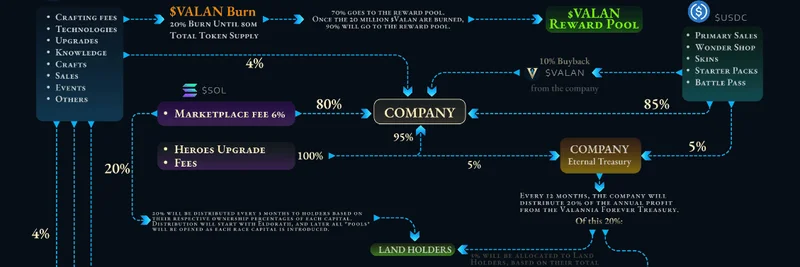
The real gem in the tweet is the infographic showing value flows and distributions in the Valannia ecosystem. It lays out how $VALAN, SOL, and USDC circulate to keep things sustainable and rewarding.
Here's a simple breakdown of how it works:
$VALAN Burns and Rewards: When players use $VALAN in-game for crafting, tech upgrades, or events, 20% gets burned forever—reducing supply and potentially boosting value. Another 4% goes to the DAO for community governance, 4% to the company for development, and 1% each to specific land holders (Eldorath and others). The rest flows into a reward pool, incentivizing more play.
Marketplace Fees in SOL: Trades on the in-game marketplace incur a 6% fee in SOL. Of that, 80% heads to the company, but 20% is distributed quarterly to land holders in the capital city where the trade happened, based on their ownership percentage. This ties real economic value to owning virtual land.
Heroes Upgrade Fees: 100% of these fees go straight to the company to fund ongoing ops.
USDC from Sales: Primary sales, wonder shop items, skins, and battle passes bring in USDC. 85% supports the company, 10% buys back $VALAN (adding buy pressure), and 5% builds the Eternal Treasury—stored in BTC and SOL for long-term stability.
Eternal Treasury Distributions: Every 12 months, 20% of the annual profit from the treasury is shared: 17% to the DAO for voting on proposals, and 3% to land holders based on growth. This resets yearly, keeping incentives fresh.
This setup ensures value flows back to players, land owners, and the community, creating a self-sustaining loop. It's like a meme token with actual utility baked in—burns for deflation, rewards for engagement, and DAO involvement for decentralization.
If you missed it, check out the full video breakdown in their earlier tweet: Watch here. It dives deeper into how these currencies interact.
Why This Matters for Meme Token Fans and Gamers
In the world of meme tokens, where hype often trumps substance, Valannia stands out by blending meme-like virality with real gameplay. Built on Solana, it's accessible and scalable, appealing to degens and serious gamers alike. The tokenomics encourage holding and playing, with burns and buybacks that could drive $VALAN's value as the player base grows.
As blockchain gaming heats up, projects like Valannia show how memes can evolve into full ecosystems. If you're looking to level up your portfolio or just dive into a fantasy realm, keep an eye on $VALAN—it's launching today via Indie.fun.
Stay tuned to Meme Insider for more updates on emerging tokens and blockchain trends.