 Meme Insider
If you've been following the wild ride of crypto markets, you probably heard about the massive liquidation event on October 10, 2025, where over $19 billion got wiped out in a flash. Amid the chaos, Ethena's synthetic stablecoin USDe briefly lost its peg on Binance, dipping as low as 65 cents. This sparked a wave of liquidations for users holding it as collateral. But according to Ethena's founder, Guy Young (known as @gdog97_ on X), it wasn't a full-blown depeg—more like a venue-specific glitch. In a detailed thread on X, he breaks down what happened and shares advice on better oracle designs to prevent future mishaps.
Understanding the USDe Depeg Incident
USDe is Ethena's yield-bearing stablecoin, designed to maintain a $1 peg through a mix of collateral and hedging strategies on Ethereum. Unlike traditional stablecoins like USDT or USDC, which are backed by fiat reserves, USDe uses a synthetic approach with delta-neutral positions—basically balancing long and short bets to stay stable. This makes it popular in DeFi (decentralized finance) for earning yields without relying on banks.
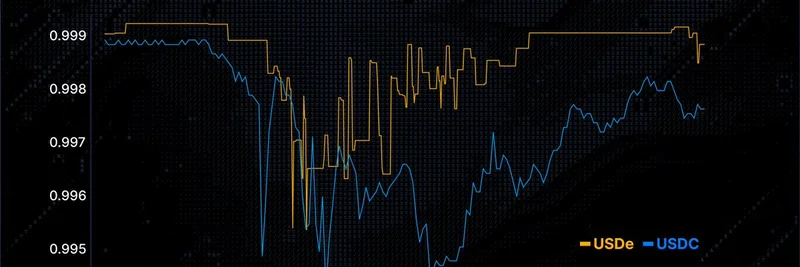
On that fateful day, the crypto market tanked, possibly triggered by external news like political announcements. Binance, one of the biggest exchanges, saw USDe's price plummet on its platform due to issues with deposits, withdrawals, and its internal oracle relying solely on its own orderbook. This led to unnecessary liquidations for traders using USDe in futures, margins, or loans. However, as Young points out, on-chain venues like Curve and Uniswap held steady with deviations under 30 basis points (that's 0.3% for the non-traders out there), similar to how USDC fluctuated against USDT.
The chart above, shared in the thread, illustrates how USDe on Curve (orange line) remained relatively stable compared to the volatility seen on Binance (blue line). Young emphasizes that Ethena's mint and redeem functions worked flawlessly, processing over $2 billion in redemptions in 24 hours without a hitch. In fact, with $9 billion in on-demand collateral, USDe acted like a wrapper for USDT and USDC during the crisis.
Binance later apologized and promised compensation to affected users, acknowledging the issue stemmed from their side.
Oracle Design and Risk Management: Key Takeaways from Ethena
Young's thread isn't just a defense—it's a blueprint for better integration of USDe across DeFi and CeFi (centralized finance) platforms. He highlights two scenarios oracles (price feeds) need to handle:
Temporary dislocations: These are short-lived price dips, common in crypto. Hardcoding USDe to equal USDT in oracles prevents unnecessary liquidations, and Young argues this saved DeFi during past events.
Permanent impairments: If the collateral is truly damaged (which hasn't happened with USDe), oracles should reflect that. Ethena offers on-demand Proof of Reserves via API to partners like Chainlink and Chaos Labs, allowing quick verification.
He invites platforms to reach out for access, stressing that exchanges should reference the deepest liquidity pools—like on-chain DEXs—in their oracles, not just internal data. This could have prevented the Binance fiasco.
How This Affects the Meme Token Ecosystem
Now, you might be wondering: What does a stablecoin depeg have to do with meme tokens? Well, in the blockchain world, everything's connected. Meme tokens like those on Solana or Ethereum often rely on stablecoins for trading pairs, collateral in leveraged positions, or even yield farming. Ethena's ENA token, the governance coin for the protocol, saw its own volatility during the event, reflecting community sentiment around USDe's stability.
Traders in the meme space frequently use platforms like Binance for futures trading, where a depeg can cascade into massive losses. This incident underscores the risks of centralized exchanges versus DeFi, where hardcoded pegs held up better. For meme token creators and holders, it's a reminder to diversify collateral and understand oracle risks—especially as more projects experiment with synthetic assets to boost yields.
If you're building or investing in meme tokens, keep an eye on integrations with stablecoins like USDe. Events like this can create buying opportunities for ENA if the protocol proves resilient, but they also highlight the need for robust risk management to avoid getting rekt.
Looking Ahead: Lessons for Blockchain Practitioners
Young wraps up by reaffirming Ethena's commitment: Ensure collateral integrity, seamless redemptions, and guidance for partners. While the event was painful, it could catalyze better practices across the industry.
As crypto evolves, staying informed on these technical nuances is key to navigating the volatility. If you're deep into meme tokens or DeFi, threads like this are gold for enhancing your knowledge base. Check out the full discussion on X for more details, and remember— in crypto, pegs can slip, but smart design keeps things anchored.